
Dual Tone IC Circuit for Railway Gate Hooter: How It Works & Why We Build These
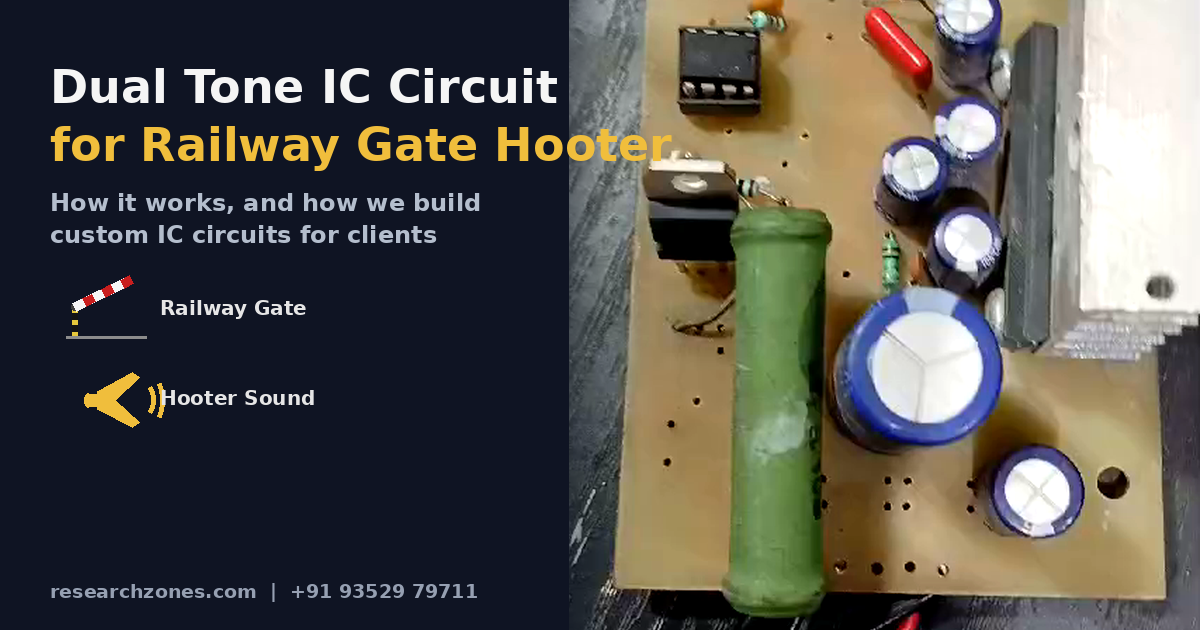
If you've ever waited at an Indian Railways level crossing, you've probably noticed the hooter doesn't just make one sound. There's a distinct tone when the gate starts closing, and a different tone once it's fully closed or reopening. That's not a coincidence — it's a deliberate dual-tone alarm system, and it's built around a surprisingly compact piece of electronics: a dual-tone IC circuit.
We recently built and tested one of these circuits in-house, and wanted to break down what's actually happening inside it — partly because it's a genuinely interesting piece of embedded electronics, and partly because custom IC-based circuits like this are exactly the kind of work we take on for clients.
What Is a Dual-Tone IC, Actually?
A dual-tone IC is a small integrated circuit designed to generate two distinct audio tones and switch between them based on an input signal — usually a simple high/low logic state. Instead of needing two separate circuits for two different sounds, one chip handles both, switching tones the instant its trigger input changes state.
In a railway gate hooter system, that trigger is tied to the gate mechanism itself:
- Gate closing / closed → Tone A plays (typically a sharper, more urgent alarm pattern)
- Gate open / opening → Tone B plays (a different pitch or pattern, signaling it's safe or in transition)
This lets pedestrians and vehicle operators distinguish the gate's state by sound alone, without needing to see it — useful in low-visibility conditions, at night, or from a distance before the barrier is even in view.
Breaking Down the Circuit
The build we tested uses a fairly standard structure for this type of alarm circuit:
Core components
- Dual-tone IC — the heart of the circuit, storing and generating both tone patterns
- Amplifier stage / power transistor — boosts the IC's weak output signal enough to drive a hooter or speaker at usable volume
- Electrolytic capacitors (multiple values) — for power supply filtering and tone-shaping, smoothing out voltage ripple so the tone stays clean
- Heatsink-mounted power component — dissipates heat from the amplification stage during sustained operation, since hooters at railway crossings run continuously while the gate is active
- Trigger input wiring — connects to the gate's open/close sensor or control relay, telling the IC which tone to output
Why this matters for reliability
Circuits like this run in outdoor, uncontrolled environments — heat, dust, vibration from passing trains, and continuous duty cycles far longer than a typical consumer electronics use case. That changes some of the design decisions:
- Components are chosen for a wider temperature tolerance than a typical hobby circuit
- The amplifier stage needs adequate heat dissipation, not just enough to survive a quick test run
- Solder joints and wiring need to handle vibration without cracking over months of continuous use
This is the difference between a circuit that works on a bench for five minutes and one that's actually reliable mounted at a live gate for years.
Where This Kind of Circuit Is Used
While railway level-crossing gates are the most recognizable example, the same dual-tone IC principle shows up in a lot of places:
- Industrial machinery state alerts (running vs. stopped)
- Security system zone alarms (perimeter vs. interior breach)
- Elevator and lift door signals
- Factory floor process-stage indicators
- Custom alert systems for automated gates and barriers in general — not just railways
If a system has two distinct states that need to be communicated audibly, a dual-tone IC circuit is usually a simpler and cheaper solution than building two separate alarm circuits.
We Build Circuits Like This
This particular build was a demonstration, but designing and programming custom IC-based circuits is a service we actively provide. If you're working on a project that needs:
- Custom dual-tone or multi-tone alarm circuits
- IC programming for specific trigger/response behavior
- Embedded circuit design for industrial, automation, or signaling applications
- Prototyping and testing before a production run
— we can design, build, and test it to your specifications. We work with clients who need a working prototype fast as well as ones who need a design refined for long-term outdoor or industrial reliability.
Contact us on WhatsApp to discuss your circuit requirements, or explore our services at researchzones.com to see the range of technical work we handle.
Chat with our team directly on WhatsApp for a quick quote or free guidance.
Related on our site
Frequently Asked Questions
What is a dual-tone IC used for?
A dual-tone IC generates two distinct audio tones and switches between them based on an input trigger signal. It's commonly used in alarms and signaling systems — like railway gate hooters — where a system needs to audibly communicate two different states.
Why does the railway gate hooter sound different when opening vs. closing?
The dual-tone IC is wired to the gate's control signal, so it automatically switches tones based on gate state — one tone for closing/closed, a different tone for open — so people can tell the gate's status by sound alone.
Can this type of circuit be customized for other applications?
Yes. The same dual-tone IC principle is used for industrial machine-state alerts, security zone alarms, elevator signals, and any system where two distinct states need distinct audible alerts.
Do you build custom IC circuits for clients?
Yes — we design, program, and test custom IC-based circuits, including dual-tone and multi-tone alarm systems, for industrial, automation, and signaling applications.
How reliable are these circuits for long-term outdoor use?
With the right component selection (wider temperature tolerance, adequate heat dissipation, vibration-resistant assembly), these circuits can run reliably for extended periods in outdoor or industrial environments — which is a key design consideration we account for in client builds.
Related Articles
0 Comments
Be the first to comment.