
Hotel Staff Fraud: How Managers Steal Room Revenue (And How to Actually Stop It)
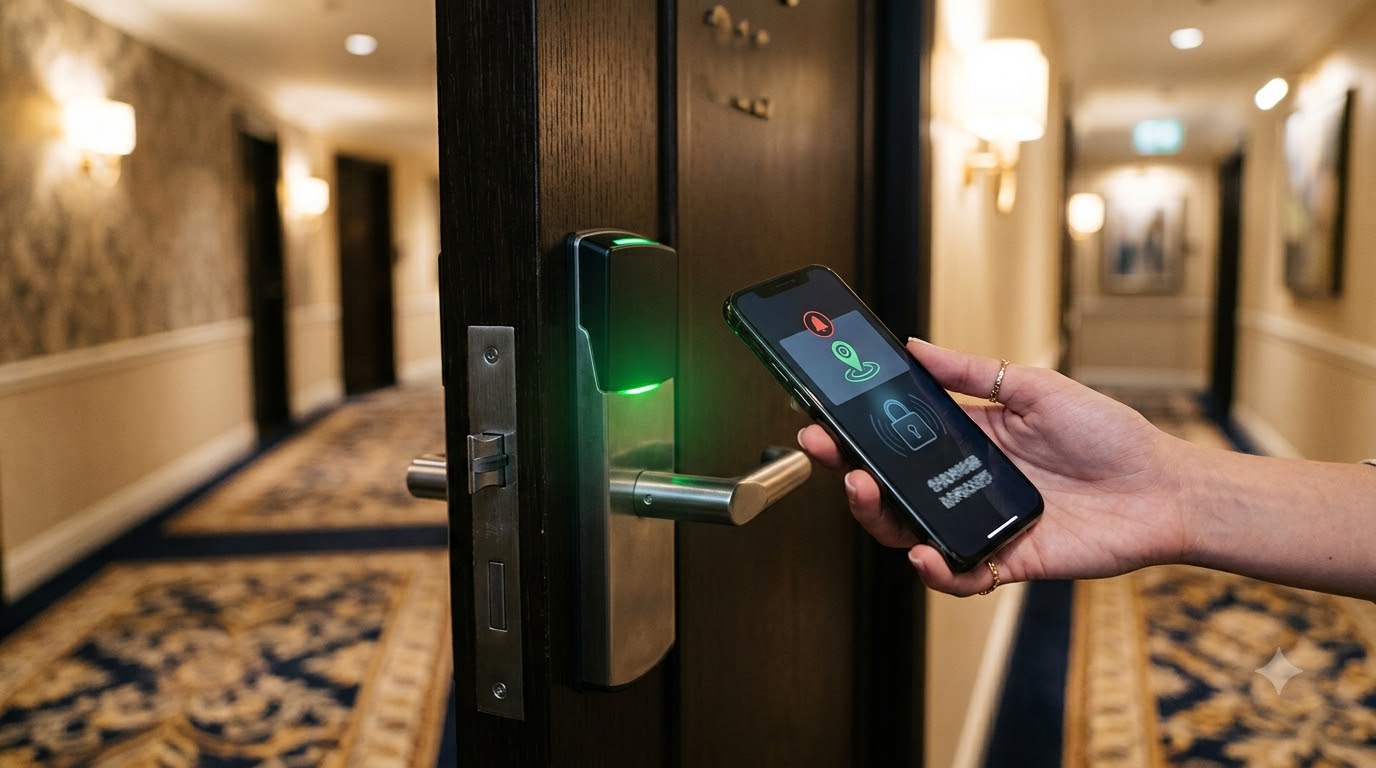
Here's a scenario that plays out in small and mid-size hotels more often than owners realize: a walk-in guest shows up, the manager takes cash directly, hands over a room key, and never enters the booking into the property management system. The guest checks out before the owner is ever in the building. The key card gets deactivated. On paper, that room was empty all night. In reality, it generated revenue that never reached the business.
Having RFID door locks doesn't prevent this. In fact, most hotel owners are surprised to learn their "modern, digital" lock system was never actually connected to anything that would stop it.
Why RFID Locks Alone Don't Prevent This
An RFID lock is a keyless entry mechanism — nothing more. Unless it's specifically integrated with your booking system, it has no concept of whether a reservation exists, whether payment was collected, or who authorized the room to be occupied. Most standalone lock systems work like this:
- Any staff member with access to the front-desk encoder can create a working room key, with or without an actual booking
- There's no requirement to check the property management system (PMS) before a card is issued
- A manager's override or master card can open any room, and its use is typically never logged anywhere
- CCTV footage, if it exists at all, usually lives on a local DVR that on-site staff can access, overwrite, or delete
This is the exact combination that makes the fraud pattern above not just possible, but easy to repeat without ever getting caught.
The Real Problem Isn't Detection — It's Prevention
Most hotel owners who suspect this is happening try to solve it by watching more closely, reviewing CCTV manually, or spot-checking occupancy — all detection-based approaches that depend on the owner catching a specific incident after the fact. The actual fix is structural: make it technically impossible to issue a room key without a verified booking and payment in the system, so there's nothing left to detect because there's nothing left to hide.
What a Properly Integrated System Actually Does
- The key encoder only generates a card once the PMS confirms a booking and payment — no confirmed reservation means no working key, regardless of who's operating the front desk
- Every card creation event is logged — staff ID, room number, timestamp, and guest ID verification, creating an audit trail that didn't exist before
- Owners get real-time mobile notifications whenever a room is accessed or assigned, whether they're on-site or on the other side of the world
- CCTV footage backs up to the cloud automatically, removing local staff's ability to delete or overwrite it
- Automated reconciliation reports compare bookings against actual room-access logs on a weekly or monthly basis, flagging any mismatch immediately instead of waiting for an owner to notice something felt off
Old System vs. Integrated System
| CapabilityStandalone RFID LockPMS-Integrated Smart Lock | ||
| Card issued without a booking | Possible | Blocked |
| Real-time owner alerts | None | Yes, via mobile app |
| Card creation audit log | None or minimal | Complete, tamper-resistant |
| CCTV footage storage | Local DVR (erasable) | Cloud-based (tamper-proof) |
| Remote visibility | None | Full visibility from anywhere |
This Isn't Just a "Small Hotel" Problem
The pattern shows up most in properties where the owner isn't physically present at all times — which describes most independent hotels, and especially anyone managing multiple properties. If you've ever had a nagging sense that occupancy and revenue don't quite line up, or that a "quiet month" felt inconsistent with what you were seeing in person, this is one of the most common (and most fixable) explanations.
How We Implement This
We deploy this as an end-to-end solution rather than a single hardware swap:
- PMS setup and configuration
- Smart lock integration with your existing or new hardware
- Cloud CCTV backup setup
- Owner-facing mobile app for real-time monitoring
- On-site staff training
- Ongoing support
If you already have RFID locks installed, in most cases we can integrate them directly rather than requiring a full hardware replacement — assessed on your existing setup, with minimum operational downtime.
This is most relevant if:
- You're not physically present at your property full-time
- You manage multiple properties and want consistent visibility across all of them
- You've had a standing suspicion of revenue leakage you haven't been able to confirm
Get Started
Request a free assessment of your current lock and CCTV setup — we'll tell you honestly what it would take to close this gap, and how quickly it can be implemented.
Talk to us on WhatsApp or explore more at researchzones.com.
Chat with our team directly on WhatsApp for a quick quote or free guidance.
Related on our site
Frequently Asked Questions
Do I need to replace my existing RFID locks entirely?
In most cases, no — if your existing locks are a compatible brand, backend PMS integration and a controller upgrade are usually enough. Full hardware replacement is only necessary when the existing lock hardware is too old or incompatible to integrate.
How long does implementation take?
For a smaller hotel (10-30 rooms), typically 1-2 weeks, including staff training.
Can I actually monitor this remotely, or is it just a dashboard I check later?
The mobile app gives real-time visibility — room access logs, CCTV feeds, and booking status — from anywhere, not just a delayed report you review after the fact.
Will my existing staff struggle to adapt to a new system?
The interface is designed to be simple, and on-site training is included specifically to make the transition smooth rather than disruptive to daily operations.
How is this different from just installing better CCTV cameras?
Better cameras only improve detection after something has already happened. This system prevents the fraudulent key issuance from being technically possible in the first place — the CCTV and audit logging are supporting layers, not the primary fix.
Related Articles
0 Comments
Be the first to comment.