
Networking Project Help for Dalhousie University Students — Design, Simulation, Security, Report & Demo
Networking projects are different from software projects. You are expected to design a topology, justify addressing and protocol choices, configure devices, test connectivity, and then explain what happens when something breaks. A configuration that works on screen but cannot be explained is the fastest way to lose marks in a demo or viva.
We offer online networking project support to students in Canada, including students of Dalhousie University in Halifax. This guide covers the kinds of projects we help with, what a strong networking project contains, and how our process works.
*ResearchZones is an independent academic support service and is not affiliated with, endorsed by, or acting on behalf of Dalhousie University. Always follow your course instructions and your university's academic integrity policy.*
Networking Project Areas We Support
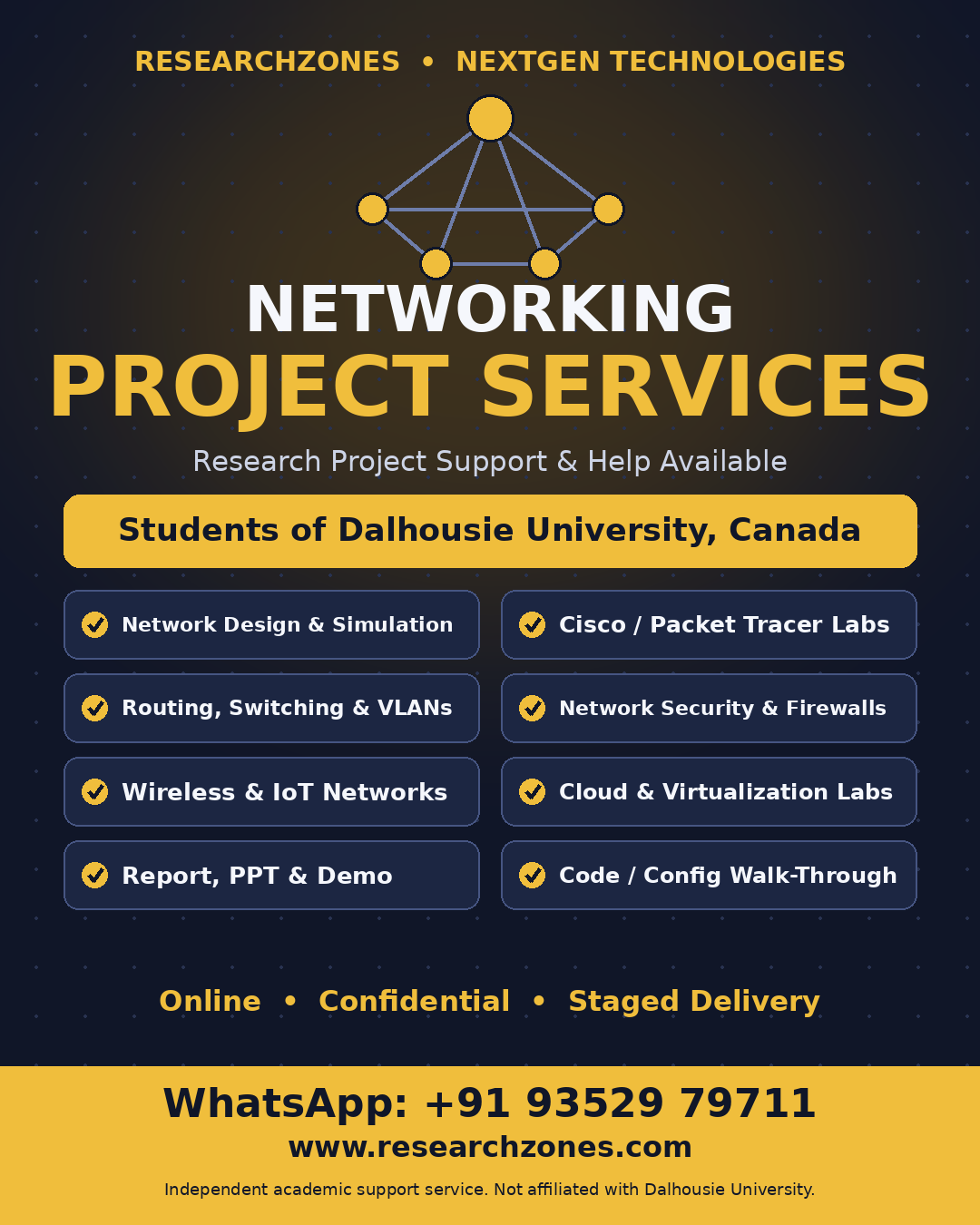
- Network design and simulation — campus, enterprise, and branch-office topologies with addressing plans
- Cisco and Packet Tracer labs — routers, switches, VLANs, inter-VLAN routing, and device configuration
- Routing and switching — static routing, RIP, OSPF, EIGRP, STP, and EtherChannel
- Network security — firewalls, ACLs, VPNs, port security, and intrusion or login-attack detection; see our cybersecurity project example
- Wireless and IoT networks — Wi-Fi design, sensor networks, and IoT solutions
- Cloud and virtualisation labs — virtual networks, virtual machines, and cloud migration planning
- Simulation-based research — NS-3, OMNeT++, or similar tools for performance studies
- Office network planning — see our office network setup checklist
What a Strong Networking Project Contains
- Clear objective — what problem the network solves
- Topology diagram — clean, labelled, and consistent with the configuration
- IP addressing and VLAN plan — a table that someone else could follow
- Configuration files — device configurations with comments
- Test evidence — ping, traceroute, show-command outputs, and screenshots
- Security measures — what is protected and how it was verified
- Failure scenario — what happens when a link or device fails, and how the design copes
- Conclusion — limitations and possible improvements
What You Receive With Our Support
- A project plan with milestones
- Topology, addressing, and configuration built in stages
- Test results and screenshots that match the configuration
- A chapter-wise report in clear, original language
- A presentation (PPT) built from the report
- A call where we explain the design, commands, and likely viva questions, so you can answer confidently
For a larger package of this kind, see our master's networking project package with custom PPT, poster, and seminar.
Common Mistakes in Networking Projects
- Topology diagram that does not match the configured devices
- Addressing errors or overlapping subnets
- Missing test evidence — only a "working" screenshot
- Security described but not demonstrated
- Report copied from a lab manual or an online tutorial
- No explanation of why one protocol was chosen over another
- Demo that depends on a setup that was never rehearsed
Original Work and Similarity Checking
Reports are written for your project, not from reused text. We run similarity checks and rewrite flagged passages properly, then edit them into natural, specific wording. Universities and tools use different thresholds, so we work to your institution's limit. We cannot honestly promise one score on every similarity or AI-detection tool.
Online Support Across Time Zones
Halifax is on Atlantic Time and our team is in India. We schedule calls in your time zone, share files in a workspace you can review, and keep progress visible through staged delivery.
What We Can Honestly Promise — and What We Cannot
We commit to: a working, explainable project, original writing, similarity review, staged delivery, a walk-through, and revision support.
We do not promise: a particular grade or outcome. Your university and markers decide. Please follow your course instructions and academic integrity policy, and use support so you can explain and defend the work yourself.
Get Started
Send your course, project brief, tools required, and deadline. We will tell you what is realistic.
Talk to us on WhatsApp or read our ready-made projects for last-minute submission guide.
Chat with our team directly on WhatsApp for a quick quote or free guidance.
Related on our site
Frequently Asked Questions
Do you offer networking project help to Dalhousie University students?
Yes. We provide online networking project support to students in Canada, including Dalhousie University students. We are an independent service and are not affiliated with the university.
Which tools do you work with for networking projects?
Cisco Packet Tracer, GNS3-style labs, virtual machines, and simulators such as NS-3 and OMNeT++, depending on your project brief.
Do you help with network security projects too?
Yes — firewalls, ACLs, VPNs, port security, and detection and alerting systems.
Will I understand the configuration well enough for the demo or viva?
That is part of the process. We walk through the design, commands, test results, and likely questions on a call.
Can you guarantee marks?
No. Your university and markers decide results. We guarantee a working, explainable project, original writing, similarity review, and revision support.
Is the report original and similarity-checked?
Yes. We write for your project, run similarity checks, and rewrite flagged passages. Thresholds differ by university and tool, so we cannot promise one score on every detector.
How do you handle the time difference with Canada?
We agree call times in your time zone and share drafts in documents you can review at any hour.
Can I get help with just the report or PPT?
Yes. Support is modular — design, configuration, testing, report, PPT, or walk-through.
Related Articles
0 Comments
Be the first to comment.