
IoT Solution Development Services — From Sensor to Dashboard
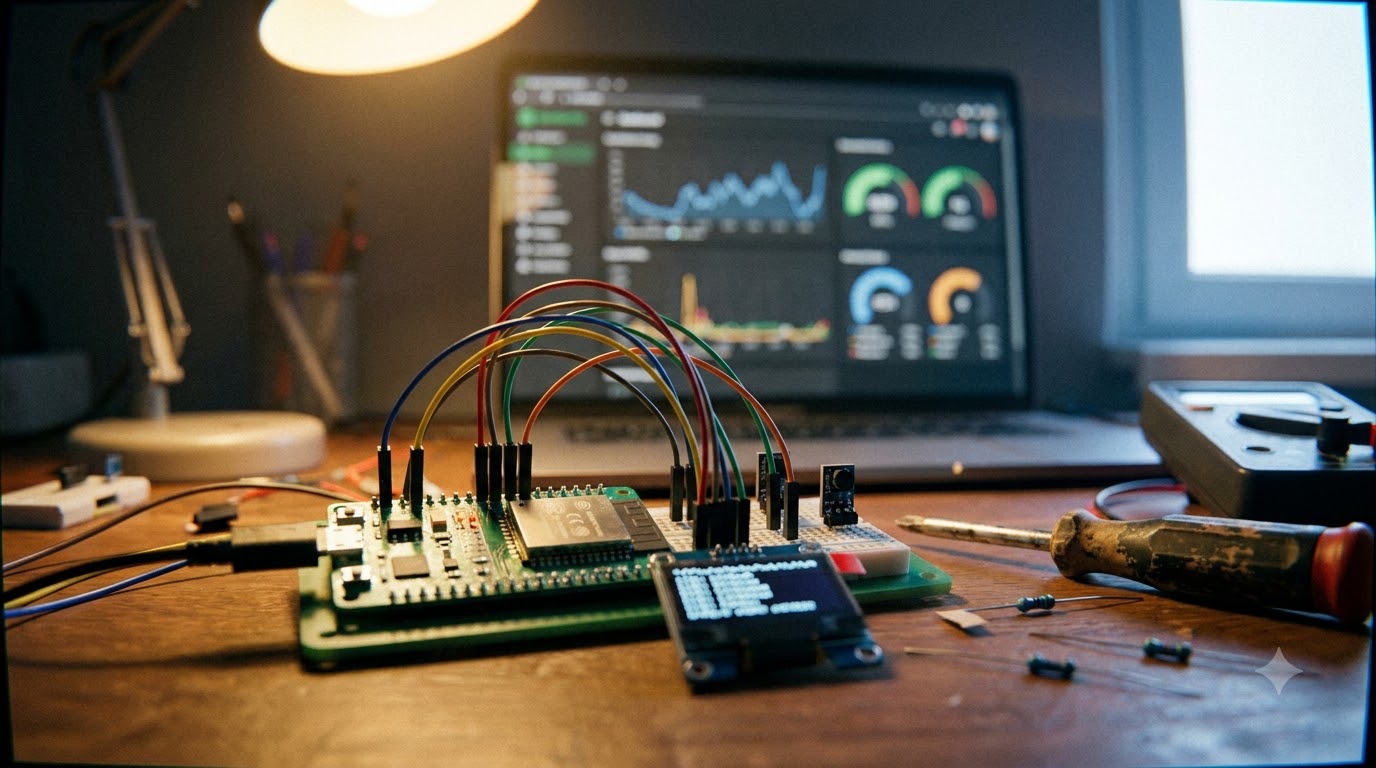
An IoT product is four things that must work together: the device, the connection, the backend, and the interface people actually use. Most failed IoT projects were built by someone who was strong at one of these and weak at the rest. We build the whole chain — hardware, firmware, cloud, and app — so it works as one system.
What an IoT Solution Is Made Of
- Sensors and hardware — measuring temperature, humidity, gas, motion, power, level, location, and more
- Microcontroller firmware — the code that reads sensors and controls outputs reliably
- Connectivity — Wi-Fi, Bluetooth, GSM/4G, LoRa, or RS-485, chosen to fit the location and power budget
- Cloud backend — receives, stores, and processes the data, with alerts and rules
- Dashboard or mobile app — live readings, history, alerts, and remote control
IoT Systems We Develop
Monitoring Systems
Temperature, humidity, water level, air quality, and energy monitoring with live dashboards and threshold alerts.
Automation & Control
Remote switching, scheduling, and rule-based control for lighting, pumps, motors, and appliances.
Asset & Vehicle Tracking
GPS-based tracking with location history and geofence alerts.
Smart Agriculture & Industry
Soil moisture, irrigation control, machine status, and production monitoring.
RFID & Access Systems
Card-based access, attendance, and tracking — the same technology behind our hotel RFID and PMS solutions.
Why Hardware and Software Under One Roof Matters
When one team handles the board, the firmware, and the cloud, problems get solved faster. A data glitch might be a sensor wiring issue, a firmware bug, or a server error — and finding which one shouldn't take three vendors pointing at each other. Our hardware work includes microcontroller programming, PCB design, and research and development, so prototypes can move to a proper product.
Our IoT Development Process
- Define the problem — what to measure, how often, and what action should follow
- Select hardware and connectivity — based on environment, range, power, and cost
- Prototype — a working proof of concept to validate before scaling
- Firmware and cloud development — reliable code, secure communication, and a data backend
- Dashboard / app — simple views for the people who'll use it daily
- Field testing — real-environment testing for stability, range, and power use
- Deployment and support — installation guidance, documentation, and maintenance
Who This Is For
- Businesses wanting to monitor or automate operations
- Startups building a connected hardware product
- Institutions needing smart-campus or lab systems
- Students and researchers needing IoT for advanced projects
Start Your IoT Project
Describe what you want to measure or control and where it will run. We'll suggest the architecture and a realistic first version.
Talk to us on WhatsApp or visit researchzones.com.
Chat with our team directly on WhatsApp for a quick quote or free guidance.
Frequently Asked Questions
What does an IoT solution development service include?
Hardware selection, firmware, connectivity, a cloud backend, and a dashboard or mobile app — plus testing and documentation.
Can you build a custom IoT device from scratch?
Yes — from schematic and PCB design through firmware and enclosure guidance, depending on the project.
Which connectivity should I choose — Wi-Fi, GSM, or LoRa?
It depends on range, power, data volume, and location. Wi-Fi suits indoor sites, GSM/4G suits remote locations, and LoRa suits long-range, low-power sensing. We recommend after understanding your site.
Can IoT data be viewed on a mobile phone?
Yes — through a mobile app or a responsive web dashboard, with alerts by notification, SMS, or email.
Is the data secure?
We use authenticated, encrypted communication and access control as standard practice.
Can you add IoT to existing machines or equipment?
Often yes — with external sensors and gateways, without replacing the equipment.
Related Articles
0 Comments
Be the first to comment.